When the fare on your sailing falls, the obvious move is to cancel and book the same cabin again at the lower price. Sometimes that works. Often it costs more than it saves, because deposits, penalties and perks all follow their own rules. Here is how to tell which case you are in.
Try repricing first
Repricing gets you the lower fare on your existing booking, with no cancellation and no new deposit. Royal Caribbean and Celebrity both reprice before final payment under their Best Price Guarantees, and Carnival's Early Saver price protection pays the difference as onboard credit until 2 business days before sailing.
Cancelling and rebooking only makes sense when repricing is not available to you. The usual reasons:
- Your fare type is excluded from the line's program. Carnival fares other than Early Saver, such as Super Saver, do not qualify for Early Saver price protection.
- The lower fare is a different fare type. Celebrity only reprices a non-refundable deposit booking to the same fare type, so a drop on the refundable fare cannot be applied.
- The line's remedy is at its discretion and it has said no.
Check what your deposit does when you cancel
Your deposit decides most of the cost.
Refundable deposit. Before the penalty period starts, cancelling usually costs nothing. Royal Caribbean's schedule charges nothing, apart from non-refundable deposit amounts, until 75 days before sailing for 1 to 4 nights, 90 days for 5 to 14 nights and 120 days for 15 nights or longer. Celebrity publishes the same thresholds for North American residents.
Non-refundable deposit. Royal Caribbean says the full deposit is held as a penalty when you cancel outside final payment, and any other payments are refunded. It also says change fees apply to these bookings. Cancelling to rebook means paying a second deposit on top of the one you lose.
Carnival Early Saver. The deposit is non-refundable. Carnival's ticket contract says a cancellation before the final payment date returns the deposit as a non-refundable, non-transferable future cruise credit, less a $50 per person service fee, to be used for a new reservation within 12 months.
If your deposit comes back only as credit, the rebooking has to save more than the fee and whatever you cannot recover.
After final payment, the math rarely works
Once you pass final payment, cancellation penalties rise on a published schedule. On Royal Caribbean, a 5 to 14 night cruise costs 25% of the total price to cancel from 89 to 75 days out, 50% from 74 to 61 days, 75% from 60 to 31 days and 100% at 30 days or less. Carnival's 6 day or longer schedule moves from losing the deposit at 90 to 56 days out, to the greater of the deposit or 50% of the fare at 55 to 30 days, the greater of the deposit or 75% at 29 to 15 days, and 100% at 14 days or less.
A fare drop is almost never large enough to cover those charges. After final payment, the realistic options are the ones in the price drop after final payment guide: an upgrade where the line offers one, or onboard credit on Carnival Early Saver.
Count the perks, not only the fare
A new booking is priced with today's promotions, not the ones you booked with. If your original booking came with onboard credit, a drinks or Wi-Fi bundle, a reduced second guest fare or an agent's gift, some of that may not come with the new one. The fare can fall and the total value can still go down.
Also check:
- The cabin itself. If you picked a specific stateroom, it may not be available again once released. Many people book the new reservation first and only cancel the old one once the new one is confirmed.
- Group and special rates. If you booked as part of a group or on a rate you qualified for at the time, ask whether a new booking can be made on the same terms.
- Your agent. If an agent booked the cruise, involve them. The travel agent guide covers why.
A quick way to decide
Cancel and rebook when all of these are true: repricing is not available, you are before the penalty period, your deposit is refundable or the saving clearly beats what you lose, and the new booking keeps the perks you care about. If any of them is false, ask the line to reprice, or look at what it offers instead.
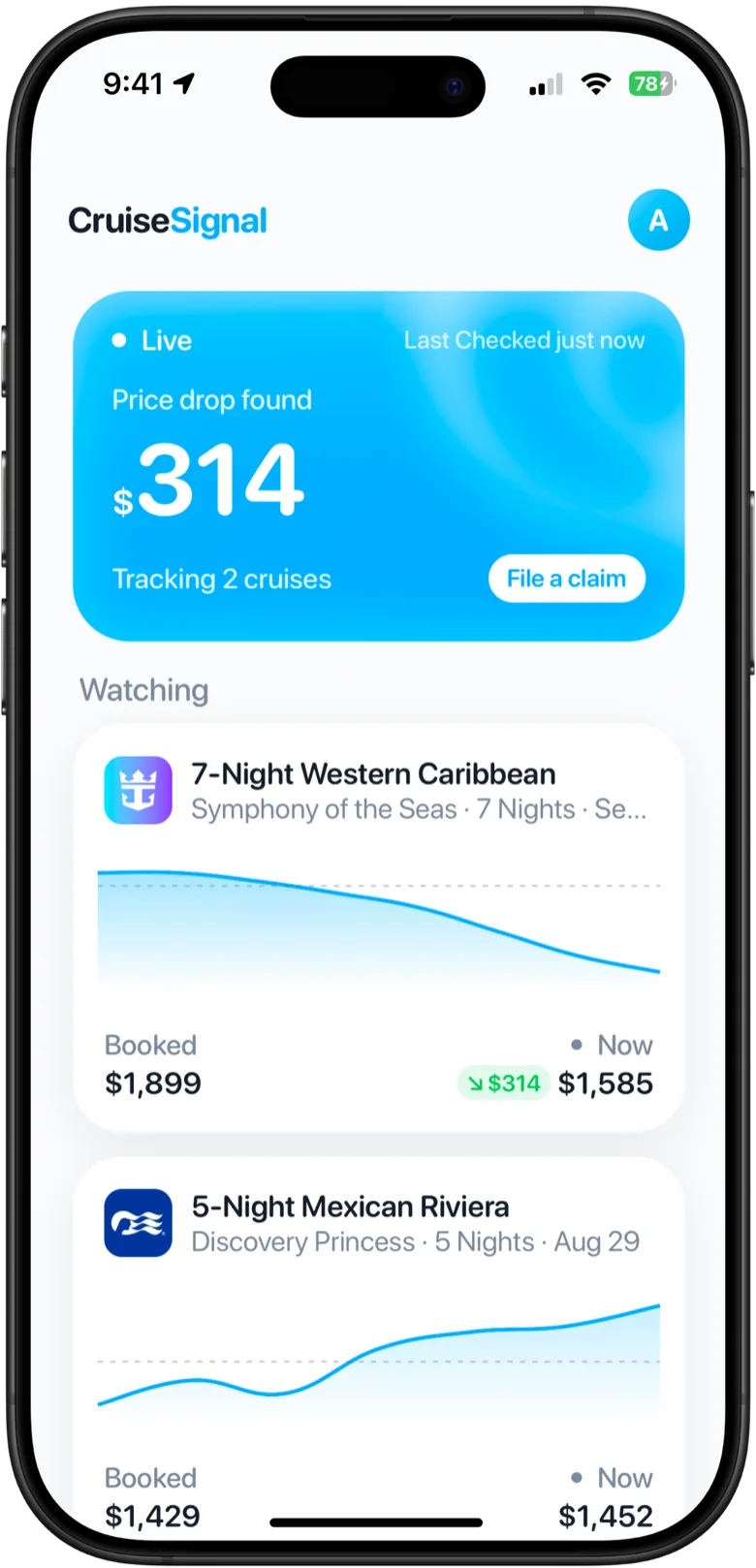
CruiseSignal watches your exact sailing and tells you the amount a fare dropped, the policy it falls under and your final payment date, so you can make that call while the drop is still worth money.