Your fare can fall after you book and the cruise line will not tell you. Two tools try to close that gap in different ways: Cruiseline.com's price alerts and CruiseSignal. Both are built on the same idea, that a lower price after booking is worth asking the line about. They differ in what they watch and what they tell you.
What Cruiseline.com price alerts do
Cruiseline.com is a cruise community and advice site. Its price alert page asks you to pick a cruise line, ship, sail month and cruise, then enter your email. It says it will email you whenever fares rise or fall, and it tells readers who have already booked to set one up anyway, because a drop is something you can ask your cruise line about.
According to Cruiseline.com's own guide to the tool, the alerts are free, you do not need to be a member (an email address is enough), and you can also set one from any search result or from its ShipMate app. The line list on the alert page is long, covering the big ocean lines as well as river, expedition and luxury brands.
One detail matters for anyone who has already booked. The same guide says the alerts track the lowest available price in a broad group (Inside, Oceanview, Balcony or Suite), and that the specific categories inside each group can move independently, so one dropping does not mean they all have.
What CruiseSignal does differently
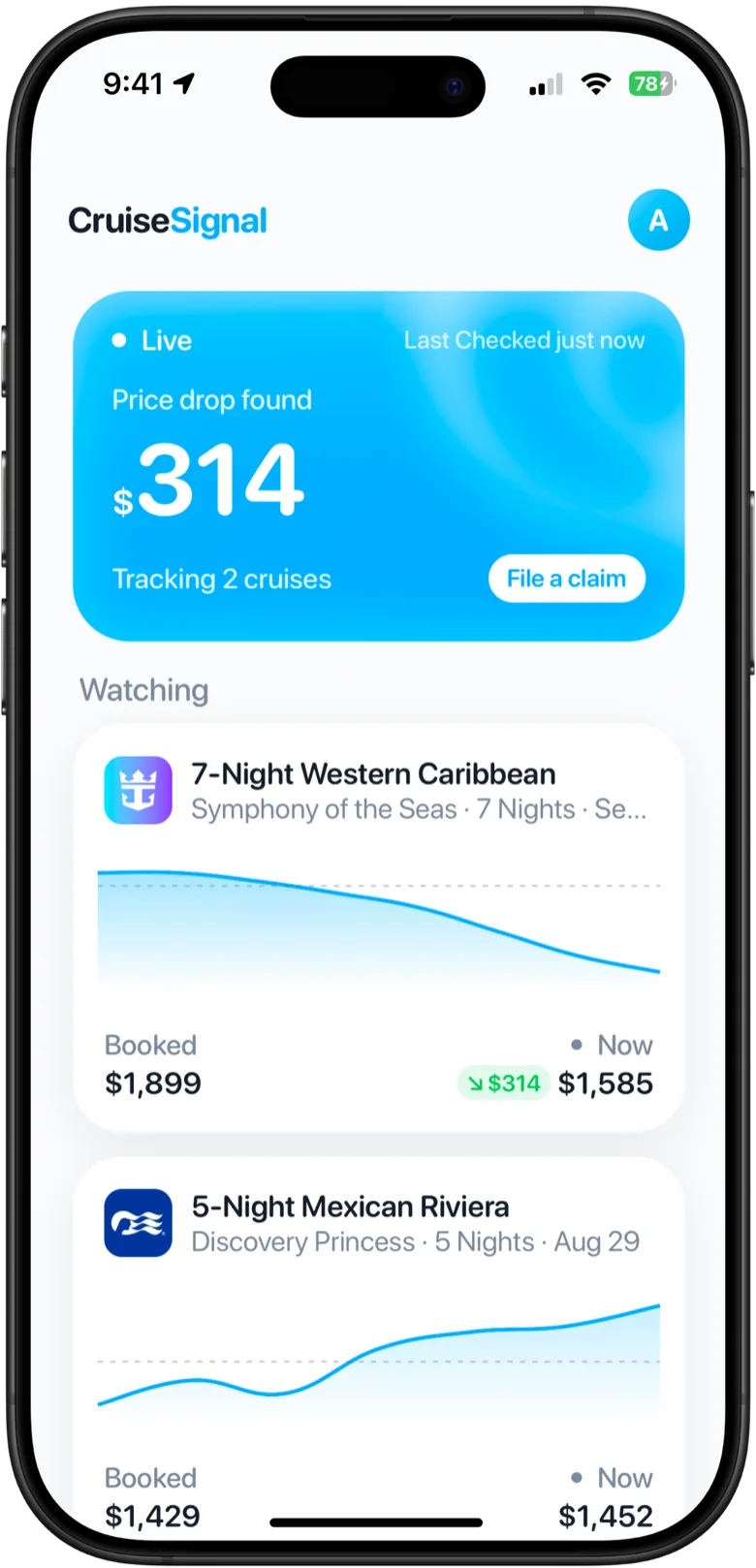
CruiseSignal starts from the booking you already hold rather than the sailing in general. You add the exact ship, sail date, stateroom category and guest count, and it watches the public price of that configuration around the clock. That matters because a claim is judged on your category, not on the cheapest balcony somewhere on the ship.
When the price drops it sends a push notification with the amount, the program that applies on your line and the deadline to act. It tracks Royal Caribbean, Carnival, Norwegian and Celebrity for travellers in the US and Canada, and it never asks for your cruise line password. It is an iPhone app, free to download, with a subscription for continuous tracking.
What neither tool does is file the claim. The booking holder or their travel agent has to contact the line, which is the same point Cruiseline.com's guide makes. Our guide on how to get a price drop on a cruise walks through that step.
Side by side
| Compared | Cruiseline.com price alerts | CruiseSignal |
|---|---|---|
| What it watches | A sailing, by broad cabin group | Your exact ship, date, category and guests |
| How it tells you | Email when fares rise or fall | Push notification when your fare drops |
| Claim context | General advice in its guides | The program that applies and its deadline |
| Cruise lines | A long list including river and luxury | Royal Caribbean, Carnival, Norwegian, Celebrity |
| Cost | Free | Free download, subscription for tracking |
| Platform | Website and ShipMate app | iPhone |
When Cruiseline.com is the better choice
If you are still shopping, Cruiseline.com is the more natural fit. An alert on a sailing you are considering tells you when it goes on sale, and it costs nothing and needs no account. It also covers lines CruiseSignal does not track, so if you are sailing with a river, expedition or luxury brand, it is the option of the two that can watch your cruise at all.
It is also a good choice if you booked a guarantee cabin or would happily move to any cabin in the same group, because a group-level price is then close to the price you care about. And its community and advice articles are a useful place to learn how price protection works before you ever need it.
When the exact category matters
If you have booked a specific category on one of the four lines CruiseSignal covers, the question is whether that category's price fell before your final payment date. A group-level email can show a drop in a category you did not book, or miss a drop in the one you did. CruiseSignal watches the one you booked and tells you what to ask the line for.
Plenty of people use both: a free alert while they shop, then a watch on the exact booking once it is made. Either way, the difference you recover depends on somebody noticing the drop in time. More on how the tracker works is on the cruise price drop alerts page.